

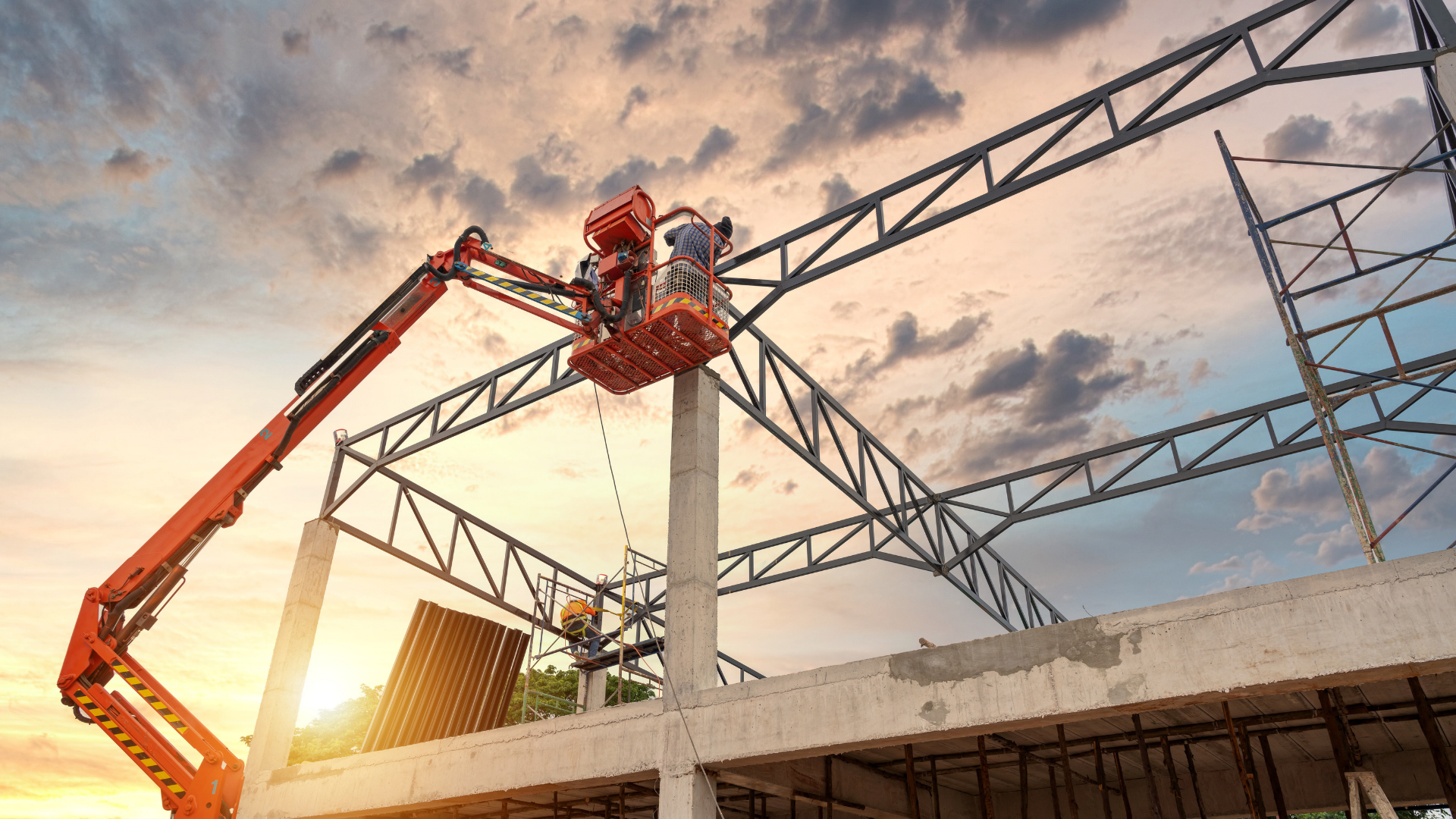
Counterbalance Valve Boom Bounce on a Man Lift
8 min read
One day, I got a frantic call from a customer along with a video attachment. A man lift was lowering its boom through a counterbalance valve (also called an overcenter valve), and the boom bounced up and down, a foot to a foot and a half each time. It did this from the top to about three feet from the ground, roughly 14 to 17 feet of travel. Only near the bottom did it settle. Nobody should climb into that bucket.
The customer’s verdict was that the overcenter valve was faulty. But it wasn’t. The overcenter valve was simply not suitable for this job. Boom bounce like this usually comes from an overcenter valve that is too touchy for the circuit, plus an operator doing the natural thing with the lever. Make the circuit less touchy, and the bounce goes.
Why does a boom bounce when lowering through a counterbalance valve?
When you lower through a counterbalance valve, the valve holds pressure on the cylinder’s load side. Pilot pressure from the other side brings that setting down until the load can move. Release the lever, the pilot pressure goes, the counterbalance valve closes, and the load stops.
Now picture a boom carrying a man in the bucket being stopped dead while it is moving. The boom, the bucket, and the cylinders all carry momentum. The whole structure overshoots and springs back. That is the bounce. If the counterbalance valve opens with very little pilot pressure, the load picks up speed quickly every time the lever goes in. The operator backs off, the valve shuts hard, and the cycle starts again. On this machine, it repeated down the whole stroke.
A case from a man lift maker: 6 lpm through a 30 lpm valve
This valve reached the machine through a hydraulics reseller, a sort of hydraulic supermarket, that sells our valves under their own name. Many brands trust their name to our quality, and we are proud of that. The catch is that the application details don’t always reach us.
The reseller supplied a maker of cherry pickers. They made their own cylinders – each with their own play. On them went our dual counterbalance valve with a 7:1 pilot ratio, rated for 35 lpm at about 7 bar pressure drop, set at our standard 100 bar. The actual flow in and out of the cylinder was about 6 lpm. At most, 7.
For a boom cylinder like this, we always recommend a single valve: a 3-port overcenter in a 4-port body (V1, V2, C1, C2), piloted internally inside the housing. There is no external pilot line, and the piping is much easier. But a supermarket sells what is on the shelf.
What made the valve so touchy
Two things stacked up.
Firstly, the 7:1 pilot ratio. Every bar on the pilot does the work of seven bar against the setting. So only a few bar of pilot pressure is enough to open the valve. The moment the pilot line sees pressure, the valve is ready to go.
The second is size. 6 lpm is 20% of the valve’s rating. A counterbalance doesn’t open wider because it is bigger. How far it opens is decided by the pressure balance across it. But a 30 lpm valve has far more opening for every fraction of a millimetre the poppet moves. At 6 lpm, the poppet works in the very first bit of its stroke, where the smallest movement makes a big difference to how easily oil leaves the cylinder. Oil takes the path of least resistance, and here that path opened up very fast.
A high ratio on an oversized valve is touchy.
What the operator’s hand has to do with it
The customer did try lowering with the lever held steady. The load came down, but quickly, and nobody was comfortable with that speed with a person in the bucket. So the operator did what any careful operator would do. He backed off the lever. The valve shut, the boom bounced, he fed the lever in again, and round it went.
You can retrain one operator. But how many operators can you train? What happens when the next one comes in? Operators change, and the next one won’t know what the last one was taught. The circuit has to be safe with whoever is on the lever.

Don’t pick a counterbalance valve off the catalogue rating
Rated flow is the most a valve will handle at a stated pressure drop. It is a ceiling, not a target. Picking the biggest counterbalance valve on the page “to be safe” is how you end up with a touchy circuit, and on a boom that shows up as bounce.
Size the counterbalance valve for the real flow coming out of the cylinder when it lowers. On the bore side, that can be more than the pump puts in, because of the area ratio. Then tell your supplier what the machine is, what the load is, what the flow is, and who will operate it. That last one matters more than people think.
The fix: an orifice disc in the cylinder port
I asked the customer to fit a throttle check valve between the counterbalance valve and the cylinder. It restricts the oil coming out when the boom lowers, and the check lets oil in freely when it raises. There was no space for one. So, a little begrudgingly, I gave them a second option. They screwed a small orifice disc, around 2 mm, into the BSP port of the cylinder, on the side the oil comes out of when the bucket is lowered. Then they reassembled the whole thing.
Now even with the counterbalance valve fully open, the oil can’t get out of the cylinder fast enough for the load to run away. The boom comes down at a speed the operator is happy with, so he has no reason to keep backing off the lever. The bounce was gone.
The disc has a cost, and we were aware of it. Unlike a throttle check, a plain orifice has no free-flow path. The same port carries oil into the cylinder when raising, so the disc sees that flow too. By our estimate, using the standard turbulent orifice equation (the International Journal of Fluid Power has a good paper on orifice discharge coefficients), at 6 to 7 lpm that is around 10 to 15 bar extra on the way up. We accepted that knowingly, because there was no room for the better part. On your own circuit, check it against your relief setting.
The orifice sits between the cylinder and the counterbalance valve, so the valve is still on the cylinder where it belongs.
What I would have done
In an ideal world, they should have used a low pilot ratio, in a valve sized for the real flow, with a throttle check valve to set the lowering speed. At a low ratio, the pilot has a weaker hand. Load pressure stays in charge, and the valve opens gradually instead of snapping open. The throttle check sets the speed on the way down and stays out of the way on the way up.
There is a small price. A lower ratio needs more pilot pressure to bring the load down, so a little more heat goes into the oil. On a 6 lpm circuit, that is a price worth paying for a boom that doesn’t bounce.
FAQ
Is my counterbalance valve faulty if the boom bounces?
Usually not. Before you replace it, check the pilot ratio, the valve’s rated flow against your real flow, and how operators actually use the lever.
Will a lower pilot ratio on the counterbalance valve stop boom bounce on its own?
It helps a lot, because the valve opens more gradually. If the load still comes down faster than operators are comfortable with, add a restriction to set the speed.
Throttle check valve or orifice disc?
A throttle check valve, if you have the space. It slows the load on the way down and lets oil in freely on the way up. An orifice disc in the cylinder port is the fallback, but it restricts both directions, so check the extra pressure when raising.
Can I size a counterbalance valve by its rated flow?
Rated flow is a ceiling, not a target. Size it for the actual flow out of the cylinder. A valve far bigger than the flow will be touchy.
Got a boom that bounces?
If you have a load that bounces or lowers in jerks, send us the circuit, the load, the real flow, and who operates the machine through our technical enquiry form. We will tell you what we would fit, and why.
Raj Dabholkar is the Technical Director of Tucson Hydrocontrols, a hydraulic cartridge valve maker in Umbergaon, Gujarat, founded in 1987. A jet propulsion engineer by degree and a hydraulic design engineer by trade, he has spent over 20 years designing valves and solving field problems with OEMs in construction, defense, earthmoving, power generation, agricultural, and industrial equipment.


