

Counterbalance Valve vs PO Check Valve: A Case Study on a Sewer Jetting and Pumping Machine
7 min read
Thirty machines were already on the road before we found out the problem was a Pilot Operated check valve doing a counterbalance valve’s job.
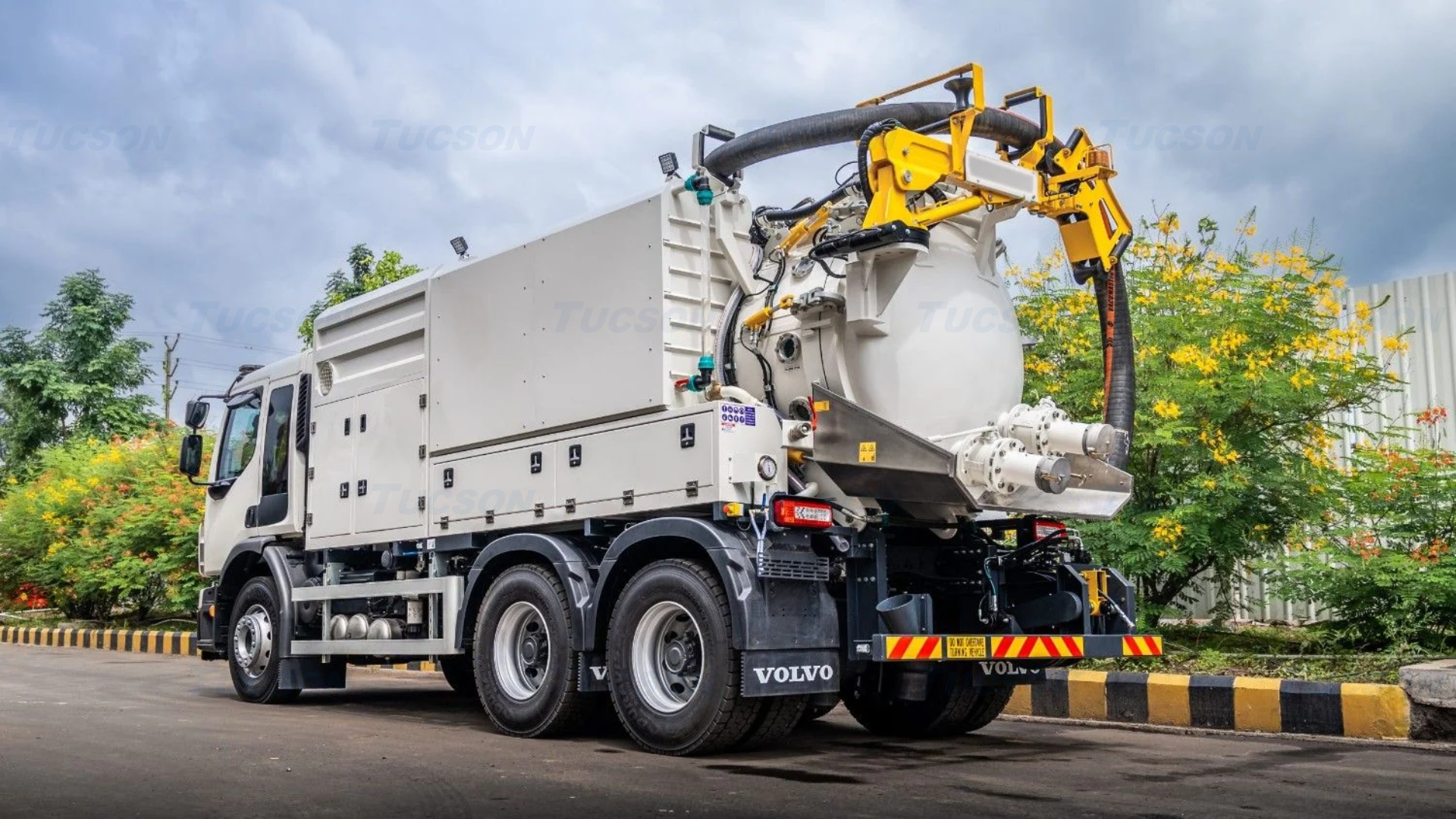
A customer of ours in North India builds sewer suction cum jetting machines. On a new model, the rear cover of the sludge tank, about 300 to 350 kg, was lowered through a pilot operated check valve (POCV). Every machine passed factory trials. Once the trucks reached the field, the complaints came in. The door jerked, stopped, and slammed on the way down.
So, here is the short answer to counterbalance valve vs. check valve, and the pilot operated kind in particular. A POCV is good at holding a load still. It is poor at letting a load come down slowly. If an operator will ever lower a load at part lever, or stop it halfway, use a counterbalance valve (CBV).
If you want the basics of how a CBV works first, start with [LINK: topic 15].
What’s the difference between a pilot operated check valve and a counterbalance valve?
A POCV is a check valve with a pilot piston behind it. Pilot pressure pushes the poppet off its seat, and oil leaves the cylinder. Take the pilot pressure away, and the poppet shuts. It is open, or it is shut. The valve itself does nothing in between.
A CBV is a pressure control valve. It holds a set pressure on the load side of the cylinder. Pilot pressure brings that setting down only as far as needed to let the load move. The load always sits on a cushion of pressure, whether it is moving or not. That is why hydraulics textbooks, like this open textbook chapter on counterbalance valves, file it under pressure control.
A case from North India: the sludge tank cover
Demand for sewer cleaning equipment has grown fast in Tier 2 and Tier 3 cities. Our customer went through a management change, and the new team started a cost-down drive. They had the sense to leave their proven products alone. The cost-cutting went into the new product lines being added to keep up with demand.
On one of those new lines, the rear cover of the sludge tank needed a motion control valve. The team picked a pilot operated check valve from another supplier. It was cheaper than a counterbalance valve, and on paper it did the job: hold the door up, let it down on command.
About 30 units went out with this setup.
Why the POCV passed factory testing
The engineers who built the machine knew exactly how it worked. During trials, they did what any of us would do. Full lever, full stroke, full flow.
At full flow, the back pressure was enough to keep the pilot line charged with high-pressure oil. That held the poppet open all the way down. The door came down clean every single time.
Nothing in the test was wrong. It matched how the people who designed the machine use it. It just did not match how operators in the field use it. That is why the problem stayed hidden until the machines were on the street.
What happened when operators got their hands on it
Operators were careful, and understandably so. Nobody wants to drop a 300 kg-plus door and break a hinge, the cylinder, or the tank. So they did two things. They fed the lever in slowly to control the lowering speed. And they started and stopped the door midway instead of bringing it down in one clean motion.
That is exactly where a POCV struggles. At part lever, there is not much pump flow. The door’s own weight pushes oil out of the cylinder faster than the pump fills the other side, so pilot pressure falls. The poppet shuts, and the door stops dead. Pressure builds again, the poppet pops open, the door drops, and the cycle repeats. Every time the operator let go of the lever midway, the poppet slammed shut, and the whole door took the jolt.
From the operator’s seat, a careful lowering felt like the machine was fighting them. That is when the complaints started. (More on this kind of jerky lowering in [LINK: topic 20].)

The fix: a 3:1, 60 lpm counterbalance valve
We replaced the POCV with a 3:1, 60 lpm counterbalance valve [LINK: product page – 3:1, 60 lpm counterbalance valve]. The door now moves like a well-greased bearing, at full lever, at part lever, and when the operator stops it halfway.
The reason is pressure control. A CBV never lets go of the load completely. It keeps holding pressure under the door and only gives way by as much as the pilot asks for. If the door tries to run ahead of the pump, pilot pressure drops and the CBV holds more pressure back on the load side. Oil always takes the path of least resistance, and the CBV makes sure that path is not the cylinder emptying under the door’s own weight. So the door goes as fast as the lever says, and no faster.
Pilot ratio is its own topic, covered in [LINK: topic 17]. One thing worth knowing: back pressure at the CBV outlet adds to its setting once oil is flowing, so the pilot needs a bit more than a static calculation shows. That is covered in [LINK: topic 22].
Holding a load or lowering a load: how to choose
The question I ask OEMs is simple. Will a person ever lower this load slowly, or stop it partway? If the answer is yes, it needs a counterbalance valve, not a check valve. A POCV is fine where the load only has to be held in place, or always moves at full lever.
And test it the way the operator will use it, not the way the engineer does. Feather the lever. Stop halfway. Start again. If the factory test is always full lever, a POCV will pass every time, and the field will tell you the truth later.
FAQ
Can I use a pilot operated check valve to lower a load?
You can, if the load always comes down at full lever. At part lever or with stop-start control, a POCV tends to chatter and jerk because it can only be fully open or fully shut.
Why does my cylinder jerk when I lower it slowly?
On a POCV circuit, the load runs ahead of the pump, pilot pressure drops and the poppet shuts, then reopens once pressure builds again. A counterbalance valve holds pressure under the load and avoids this cycle.
Is a counterbalance valve more expensive than a check valve?
Yes, the valve itself usually costs more. In this case, 30 machines in the field with an unhappy operator base cost far more than the price difference.
Where should the counterbalance valve be mounted?
As close to the cylinder as possible, ideally right on it, so a burst hose cannot drop the load. See [LINK: topic 21].
Have a load holding problem?
If you are deciding between a POCV and a CBV, or a machine is already jerking in the field, send us your circuit and how the operators actually use it through our technical enquiry form. We will tell you what we would fit and why.
Raj Dabholkar is the Technical Director of Tucson Hydrocontrols, a hydraulic cartridge valve maker in Umbergaon, Gujarat, founded in 1987. A jet propulsion engineer by degree and a hydraulic design engineer by trade, he has spent over 20 years designing valves and solving field problems with OEMs in construction, defense, earthmoving, power generation, agricultural, and industrial equipment.