

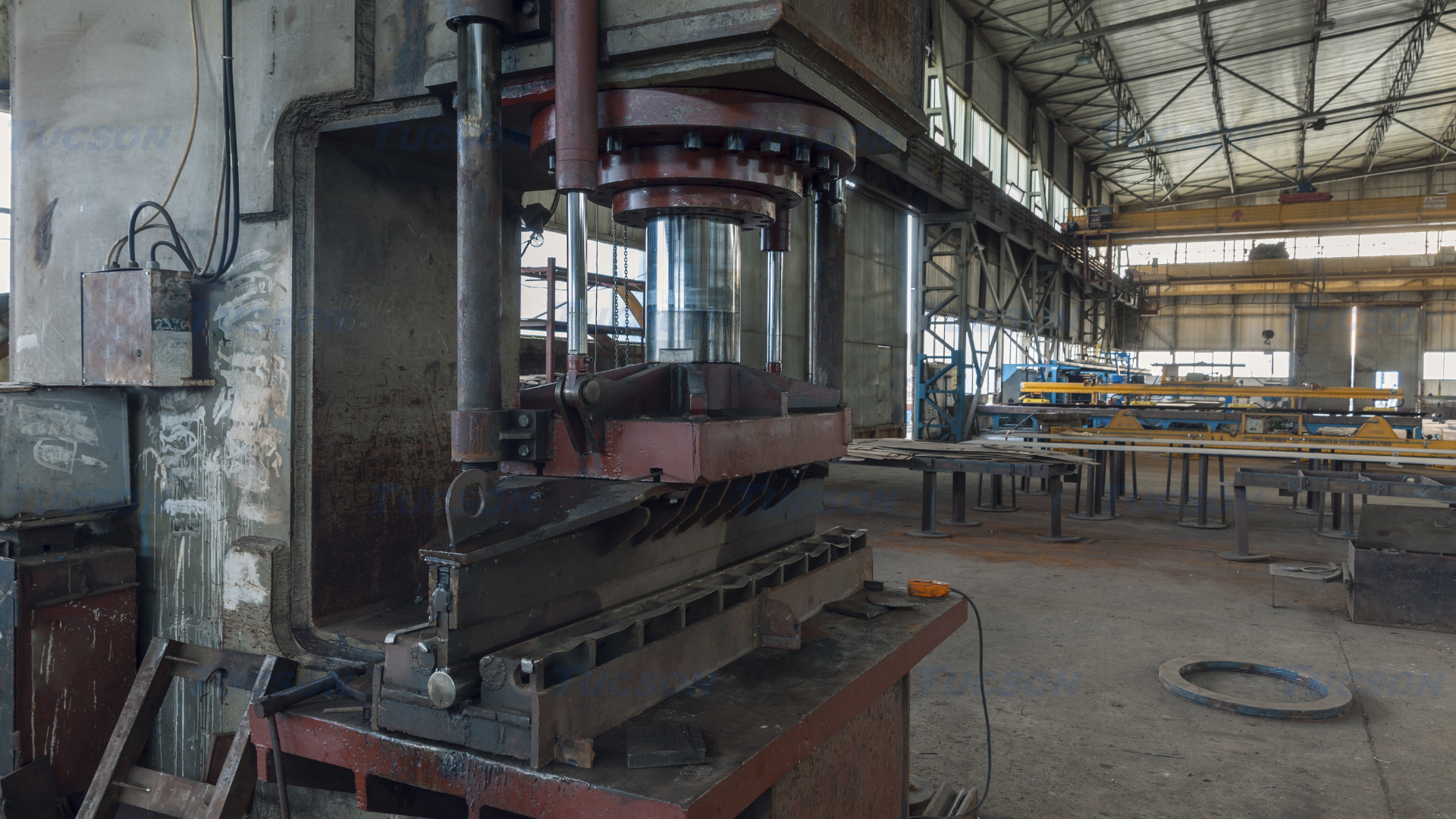
Hydraulic Press Decompression
9 min read
“Every time I unload my cylinder, there is a loud bang.” Press builders have been calling us with this line for as long as I can remember. If the frame, the guides, and the rest of the mechanics check out, the bang is almost always hydraulic press decompression done badly, or not done at all. The oil in a press cylinder is squeezed under pressure. Let it go all at once, and it goes with a bang.
Here is the short answer. Bleed off the compressed oil first, a few cc at a time through a small orifice, and only then open the main valve. The popular shortcut, a pilot operated check valve with a built-in decompression stage, behaves well on presses that always run above about 250 bar. On a press working around 100 bar it often gives trouble. A separate solenoid decompression stage works at any pressure.
For why oil compresses at all, we have another article coming up soon.
Hydraulic press decompression: why does the press bang?
Most of us learnt that oil can’t be compressed. It can. Mineral oil is usually taken to shrink by about 0.5% for every 1000 psi, which is about 69 bar. That sounds like nothing. In a press it isn’t.
Take a cylinder with a 200 mm bore and a metre of oil column behind the piston. That is about 31 litres. At 300 bar, that oil has given up roughly 680 cc of volume. At 100 bar it is still around 230 cc. Add the hoses swelling and a little air in the oil, and the real figure is higher. All of that has to come back out before the pressure reaches zero.
Squeezed oil behaves like a compressed spring. It holds energy. Open the main valve and that energy is released in a few milliseconds. The oil accelerates, the lines jump, fittings work loose and the whole shop hears it. Brendan Casey makes the same point in Machinery Lubrication: uncontrolled decompression is a big bang that stresses the lines. The old rule of thumb is to control decompression once the compressed volume goes past about 160 cc. Most presses we see are past that.
The good news is that the whole job is a handful of cc. Picture 100 cc of oil locked at 350 bar. Pure oil would give back about 2.5 cc on the way down to zero. In a real line, with hoses and a bit of air, we see closer to 5 cc. Take that out slowly and nothing happens. Take it out at once and you get the bang.
The decompression pilot check: compact, cheap and fussy about pressure
There are two common ways to decompress a press. The first is a pilot operated check valve with a decompression stage built in. A tiny pre-opening poppet inside the main poppet cracks first, bleeds the pressure down, and then the main poppet opens. The second is a separate small decompression valve that lets out a few cc, after which a standard pilot check opens. More on check valves later.
The built-in version is popular because it is one valve, and it is cheap. The catch is in the pilot ratio. A standard pilot check has a ratio of 3:1 or 4:1, 5:1 at the outside. Adding the decompression stage pushes it to about 20:1, sometimes 25:1.
On a 300 bar press, that is exactly what you want. A standard 3:1 or 4:1 pilot check needs 75 to 100 bar of pilot to open, and it opens with a bang. The decompression version opens at 12 to 15 bar, early and gently. The press goes quiet, and the customer is happy. Pilot ratio on load holding valves is covered in another topic 17.
What happens to a decompression pilot check at 100 bar?
A lot of presses don’t run at 300 bar. Many pressing jobs sit around 100 bar. Put the same 20:1 or 25:1 valve on that press and it now opens at 4 to 5 bar.
Now look at the tank line. A moderately clogged filter puts about 2 bar of back pressure on it. A badly clogged one can put 4 bar. Add the elbows, the fittings and whatever dirt is sitting in the return line. In a typical press circuit, the pilot for the check comes off the other cylinder line, and during the hold that line drains to tank through the directional valve. So whatever back pressure the return line carries is also sitting on the pilot. The valve that needs 4 to 5 bar to open now has 2 to 4 bar pushing on it all the time.
The press then holds badly, or the check cracks open when nobody asked it to. The first thing everyone suspects is the pilot check. The valve is doing exactly what it was built to do. The problem is the circuit. In my experience, a decompression pilot check only behaves when the system pressure is always above about 250 bar.
So the choice looks like this. A standard pilot check on its own gives you a loud press. A decompression pilot check on a low pressure press gives you a leaky one. It doesn’t have to be either.
The fix: separate decompression from load holding
Take the decompression job away from the pilot check and give it to its own valve. We use a small poppet-type solenoid valve with an orifice of 0.8 to 1.6 mm, connected to the pressurised side of the cylinder. It switches on a moment before the main directional valve. It lets out those few cc through the orifice, and the cylinder pressure falls close to zero. Then the main valve shifts, and a standard pilot check with a 3:1 or 4:1 ratio opens with nothing left to push. No bang.

The energy is still released, but across the orifice as a little heat instead of as noise and shock. The solenoid valve is a poppet with a metal-to-metal seat, so it seals without leakage and doesn’t spoil the hold. A spool valve can’t do this job, because spools leak across their lands by design.
This is how we handle hydraulic press decompression in our own circuits. It costs a little more than a decompression pilot check. It works just as well on a 300 bar press as on a 100 bar one, and the pilot check goes back to doing only one job, holding the load.
We recommend DC coils for the decompression valve. On an AC supply the coil needs a rectifier plug, and that rectifier can be damaged by a voltage spike. A DC coil lasts longer. More on coils later.
What we see at THPL: copied circuits, copied faults
We can often tell a press builder what his press sounds like before he describes it. A bang on every return stroke, or a long hiss. That usually gets a laugh, and then a long silence.
It isn’t that these builders don’t know their trade. Many of them learnt it at a bigger company, then set up on their own with the circuit they knew. The circuit worked well enough there, so it comes along unchanged, faults included. Nobody tells you which parts of a drawing were compromises.
The other habit is cost. A cheap spool valve does the switching, a decompression pilot check does the holding, and the press is either noisy or doesn’t hold. Many builders live with that rather than spend a little more on the circuit. The bigger press makers have mostly moved to a separate solenoid decompression stage. It is only a shade more expensive, and it stays quiet and reliable through the whole pressure range.
[IMAGE: Topic 55 – 3 Body Image | Alt: Step graphic showing hydraulic press decompression with a separate solenoid valve and orifice before the main valve opens]
FAQ
Why does my hydraulic press bang when the cylinder retracts?
The oil under the piston has been compressed and is holding energy. When the main valve opens suddenly, that energy goes all at once. Bleed off the few cc of compressed oil through an orifice before the main valve opens.
Does a small press need decompression?
Work out the compressed volume. Multiply the oil volume under pressure by about 0.5% for every 69 bar. If it comes out above about 160 cc, control the decompression. Most production presses are above that.
Can I use a pilot check with built-in decompression on a 100 bar press?
It often gives trouble. With a pilot ratio of 20:1 to 25:1, it opens at 4 to 5 bar, close to the back pressure a dirty filter and the tank line can put on the pilot. A separate decompression valve is the safer choice.
What orifice size do you use for decompression?
In our circuits, 0.8 to 1.6 mm. The right size depends on the compressed volume and how quickly you need the cycle to move on. Send us the cylinder size and pressure, and we’ll suggest one.
AC or DC solenoid for a decompression valve?
We recommend DC. AC coils on these valves need a rectifier plug, and the rectifier can fail on a voltage spike.
Press banging, or not holding?
Send us the circuit, the cylinder bore and stroke, the working pressure, and the valves you have now. We’ll tell you whether it needs decompression and what we would fit. [LINK: contact page]
Raj Dabholkar is the Technical Director of Tucson Hydrocontrols, a hydraulic cartridge valve maker in Umbergaon, Gujarat, founded in 1987. A jet propulsion engineer by degree and a hydraulic design engineer by trade, he has spent over 20 years designing valves and solving field problems with OEMs in construction, defense, earthmoving, power generation, agricultural, and industrial equipment.